

The Basics of American Football: How to Play? A Beginner's Guide
American football can seem complex at first, especially if you're not familiar with the rules. However, once you understand the basics, it becomes an exciting sport to both watch and play. This beginner's guide will explain the fundamentals of American football, from the objective of the game to the various ways to score points, as well as the main rules and positions on the field.
The Goal of the Game in American Football
The main objective of American football is simple: score more points than the opposing team. To do so, a team must advance the ball into the opponent's end zone. There are several ways to score points:
- Touchdown (6 points): When the ball crosses the goal line, either by carrying it or catching it in the end zone, a team scores a touchdown. This is the primary goal of the game.
- Extra point (1 or 2 points): After scoring a touchdown, the team can attempt to score an additional point by kicking the ball between the goalposts (extra point), or they can try to score two points by running a play from the 2 or 3-yard line (two-point conversion).
- Field goal (3 points): If the offensive team fails to score a touchdown but is close enough, they can attempt a field goal, which is worth three points if the ball goes between the goalposts.
- Safety (2 points): If the offensive team is tackled in their own end zone, the defensive team scores two points.
How the Field and the Game Work
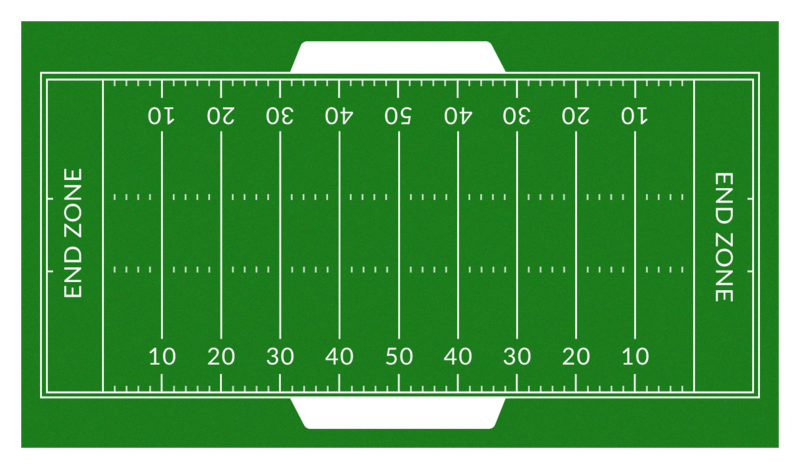
An American football field is a rectangle, 110 meters long, including the two end zones of 9.14 meters (10 yards) at each end. The width of the field is approximately 48.75 meters (50 yards). The game begins with a kickoff, and teams alternate between offense and defense.
Downs and Advancing the Ball
The offensive team has four attempts or "downs" to advance the ball 10 yards. If they succeed, the downs are reset, and they get another set of four downs to move another 10 yards. If the team fails, they can choose to attempt a field goal, punt the ball (kick it away), or turn it over to the opposing team.
The Line of Scrimmage and the Role of the Quarterback
At the start of each play, teams line up on opposite sides of the line of scrimmage. The center snaps the ball to the quarterback, who then decides whether to run with it, pass it, or hand it off to a running back to advance.
The Defense
The defensive team's goal is to prevent the offense from advancing, either by tackling the ball carrier, intercepting passes, or causing fumbles (ball turnovers). If the defense recovers the ball, they can attempt to score a touchdown.
Game Duration and Timing
A football game consists of four quarters of 15 minutes each. However, a game typically lasts about 3 hours, with frequent stoppages due to timeouts, penalties, and breaks between plays. The clock stops when there is an incomplete pass, when points are scored, or when a player goes out of bounds in the final two minutes of the first half or five minutes of the second half.
Key Positions on the Field
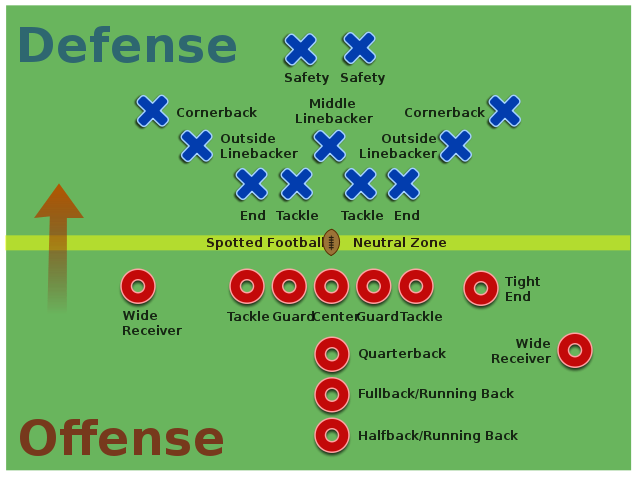
Each team has 11 players on the field at any given time. Players are divided into two main groups: offense and defense.
Offensive Positions
- Offensive Line: Made up of five players (tackles, guards, center), their main job is to protect the quarterback and open running lanes for the running backs.
- Quarterback (QB): The leader of the offense, responsible for passing the ball, running with it, or handing it off to other players.
- Running Back (RB): Carries the ball to gain yards and sometimes catches passes.
- Fullback (FB): A blocker for the running back and quarterback, and sometimes carries the ball.
- Wide Receiver (WR): Fast players who run routes to catch passes.
- Tight End (TE): A hybrid position that can block and catch passes.
Defensive Positions
- Defensive Line: Made up of defensive tackles and defensive ends, their job is to disrupt the offensive line and tackle the ball carrier.
- Linebackers (LB): Positioned behind the defensive line, linebackers cover running backs, tight ends, and wide receivers; they rush the passer and tackle ball carriers.
- Cornerback (CB): Typically the fastest defensive players, responsible for covering wide receivers and intercepting passes.
- Safety: The last line of defense, covering deep passes and supporting the run defense.
Special Teams
Special teams come into play during kickoffs, punts, and field goal attempts.
- Kicker: Responsible for field goals and kickoffs.
- Punter: Kicks the ball away on a punt when the offense fails to convert.
- Kick Returner: Receives kickoffs and attempts to run the ball back for a good gain.
- Punt Returner: Similar to the kick returner but responsible for returning punts.
- Long Snapper: The player who snaps the ball to the punter or kicker.
Recap of Basic Rules and Strategies
- 4 downs to advance 10 yards.
- Touchdown (6 points): Score by reaching the opponent’s end zone.
- Field goal (3 points): Kick the ball through the goalposts.
- Extra point (1 or 2 points): After a touchdown, attempt an extra point or two-point conversion.
- Safety (2 points): The defensive team scores by tackling the ball carrier in their own end zone.
Conclusion: Why American Football is Exciting
American football is a strategic and intense sport where every player and every play matters. With simple rules but plenty of opportunities for exciting action, it's easy to see why this sport is so popular, especially in North America. By following this guide to the basics, you'll be ready to better understand the game, whether you're watching or playing as a beginner.